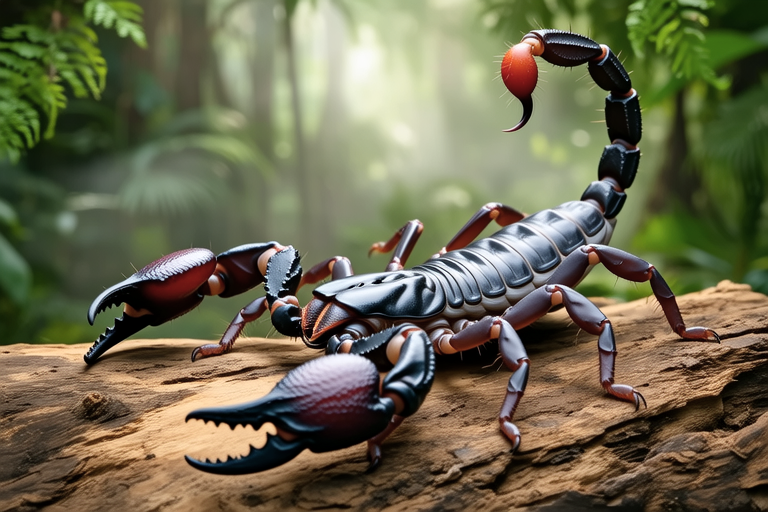
Heterometrus Spinifer: The Jungle’s Silent Guardian
In the heart of Southeast Asian jungles, where the air is thick with humidity and the canopy buzzes with life, there exists a creature that has mastered the art of survival. This enigmatic guardian of the jungle is none other than Heterometrus spinifer, a species of scorpion that has captivated the imagination of scientists and nature enthusiasts alike. With its distinctive physical characteristics, intriguing behavior, and crucial ecological role, Heterometrus spinifer stands as a testament to the remarkable adaptations that have allowed it to thrive in one of the most diverse ecosystems on Earth.
Physical Characteristics
At first glance, Heterometrus spinifer might seem like an ordinary scorpion, but a closer look reveals its unique features. Adult specimens typically measure between 8 and 10 centimeters in length, making them among the largest scorpions in their habitat. Their bodies are characterized by a robust exoskeleton that provides both protection and support. The carapace, which covers the head and thorax, is adorned with sharp spines that serve multiple purposes. These spines are not only used for defense but also play a role in mating rituals and prey capture. The pincers, or pedipalps, are large and powerful, capable of delivering a formidable grip on unsuspecting prey. The tail, or metasoma, ends in a venomous stinger, a weapon that is both a means of self-defense and a tool for hunting.
The coloration of Heterometrus spinifer is another aspect of its physical makeup that aids in its survival. Typically ranging from dark brown to black, these scorpions blend seamlessly into the leaf litter and soil of their jungle home. This camouflage makes them nearly invisible to predators and prey alike. Additionally, their legs are equipped with tiny sensory hairs that allow them to detect vibrations in the ground, helping them locate potential threats or food sources even in complete darkness.
Behavior and Habitat
Heterometrus spinifer is primarily nocturnal, spending the daylight hours hidden beneath rocks, logs, or within crevices in the jungle floor. As night falls, these scorpions emerge to hunt, moving with surprising speed and agility through the underbrush. They are solitary creatures, preferring to live alone rather than in groups, and they mark their territories with pheromones to avoid encounters with other scorpions. Males engage in elaborate courtship dances to attract females, using their pedipalps to gently grasp the female’s pincers and perform a series of coordinated movements. Once mated, the female will carry her eggs internally until they hatch, after which she will guard her young for several weeks before they disperse.
The jungle environment presents numerous challenges for Heterometrus spinifer, but the scorpion has evolved a suite of behaviors that help it overcome these obstacles. For example, during periods of heavy rainfall, when the jungle floor becomes flooded, these scorpions are known to climb trees to avoid drowning. This arboreal behavior is rare among scorpions and highlights the versatility of Heterometrus spinifer in adapting to changing conditions. In addition to their climbing abilities, these scorpions are adept swimmers, capable of navigating small streams and ponds in search of food or shelter.
Diet and Feeding Habits
As opportunistic predators, Heterometrus spinifer feeds on a wide variety of prey, including insects, spiders, small vertebrates, and even other scorpions. Their diet reflects the abundance of life in the jungle, where resources are plentiful but competition is fierce. The scorpions use their keen sense of touch and vibration detection to locate prey, often ambushing unsuspecting victims from their hiding places. Once a target is identified, the scorpion will approach cautiously, using its pincers to grab the prey and bring it close enough to sting. The venom injected into the victim paralyzes it, allowing the scorpion to consume its meal at leisure.
Interestingly, Heterometrus spinifer does not rely solely on its venom to subdue prey. While the stinger is certainly effective, the scorpion’s powerful pincers can deliver a crushing blow to smaller insects, rendering them helpless without the need for venom. This dual approach to hunting ensures that the scorpion can efficiently capture a wide range of prey, from soft-bodied insects to tougher arachnids and small lizards.
Ecological Role
Within the complex web of life in the Southeast Asian jungle, Heterometrus spinifer plays a vital role as both predator and prey. As top predators in their microhabitats, these scorpions help control populations of insects and other small animals, preventing any single species from becoming too dominant. By doing so, they contribute to the overall balance of the ecosystem, ensuring that no one organism monopolizes resources and that biodiversity is maintained.
On the flip side, Heterometrus spinifer serves as an important food source for larger predators, including birds, mammals, and other reptiles. Their presence in the ecosystem helps sustain the food chain, providing energy to higher trophic levels. Additionally, the scorpions’ burrowing habits and leaf litter-dwelling behavior contribute to nutrient cycling in the soil, breaking down organic matter and releasing essential nutrients back into the environment. This process enriches the soil, promoting plant growth and further supporting the diverse array of life in the jungle.
Adaptations to the Jungle Environment
The Southeast Asian jungle is a challenging environment, characterized by high humidity, dense vegetation, and unpredictable weather patterns. To survive in such conditions, Heterometrus spinifer has developed a range of adaptations that allow it to thrive. One of the most notable adaptations is its ability to tolerate extreme temperatures. The scorpion’s exoskeleton acts as a natural insulator, protecting it from both heat and cold. During the hottest parts of the day, the scorpion retreats to cooler, shaded areas, while at night it takes advantage of the warmer temperatures to become more active.
Another key adaptation is the scorpion’s water conservation strategy. Given the humid climate, water is abundant in the jungle, but Heterometrus spinifer still needs to be efficient in its use of this resource. The scorpion’s exoskeleton is impermeable, minimizing water loss through evaporation. Additionally, the scorpion can reabsorb moisture from its own waste products, further reducing the need for external water sources. This ability is particularly useful during dry spells, when water may be scarce.
Cultural and Scientific Significance
In many Southeast Asian cultures, scorpions are viewed with a mixture of fascination and fear. Legends and folklore often depict scorpions as symbols of danger and mystery, reflecting the awe and respect that people have for these creatures. In some regions, scorpions are believed to possess mystical powers, and their venom is sometimes used in traditional medicine. However, it is important to note that the use of scorpion venom in this way can be dangerous and should only be performed by trained professionals.
From a scientific perspective, Heterometrus spinifer offers valuable insights into the evolution of venom and the development of specialized hunting techniques. Researchers are particularly interested in the chemical composition of the scorpion’s venom, which contains a cocktail of toxins that can affect the nervous system of its prey. Understanding these toxins could lead to breakthroughs in the development of new drugs and treatments for various medical conditions. Additionally, studying the scorpion’s behavior and ecology provides a window into the intricate relationships that exist within tropical ecosystems, helping us better understand how these environments function and how they can be protected.
Conservation Efforts
Despite their resilience and adaptability, Heterometrus spinifer faces threats to its survival, primarily due to habitat destruction and fragmentation. As human activities such as deforestation, agriculture, and urbanization encroach upon the jungle, the scorpions’ natural habitats are being destroyed, leaving them with fewer places to live and hunt. Additionally, the use of pesticides and other chemicals in agricultural practices can have detrimental effects on scorpion populations, either directly through poisoning or indirectly by reducing the availability of prey.
To address these challenges, conservationists are working to protect the remaining habitats of Heterometrus spinifer and promote sustainable land-use practices that minimize the impact on wildlife. Protected areas, such as national parks and wildlife reserves, provide safe havens for the scorpions and other species, allowing them to continue playing their vital roles in the ecosystem. Public education campaigns are also underway to raise awareness about the importance of preserving biodiversity and the specific threats facing Heterometrus spinifer. By fostering a greater understanding and appreciation for these creatures, we can inspire action to safeguard their future.
In conclusion, Heterometrus spinifer is a remarkable species that exemplifies the beauty and complexity of life in the Southeast Asian jungle. Its unique physical characteristics, fascinating behavior, and crucial ecological role make it a subject of great interest for both scientists and nature lovers. As we continue to explore and learn from this magnificent creature, it is our responsibility to ensure that it and its habitat are protected for generations to come. Through conservation efforts and a deeper understanding of the scorpion’s place in the ecosystem, we can help preserve the rich biodiversity of the jungle and the countless species that call it home.
